Are Smoke Curtains and Fire Curtains the Same?
No, smoke curtains and fire curtains are not the same. Although both are active barrier systems used in buildings during a fire event, they are designed for different functions and are assessed against different performance criteria.
What is the main difference?
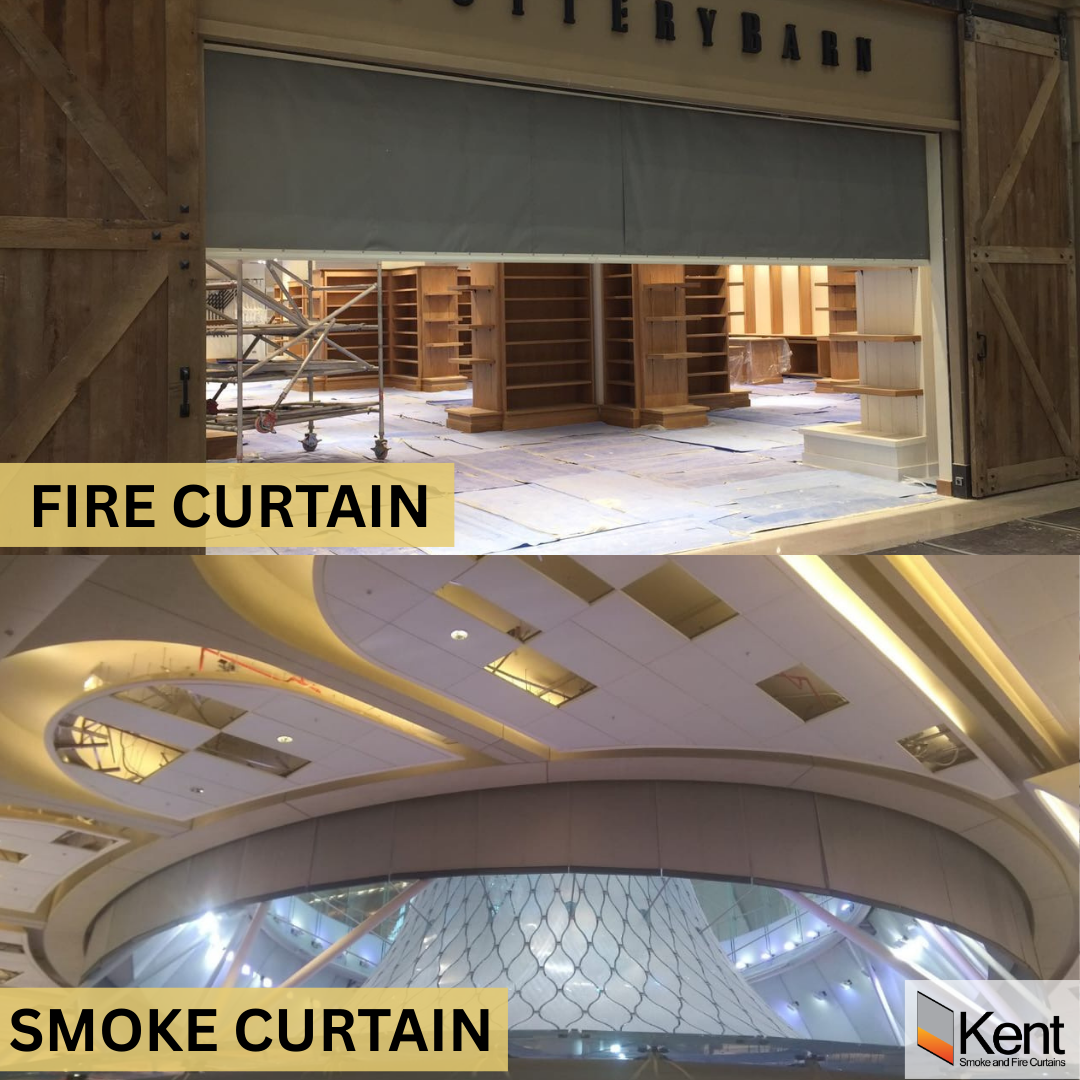
A smoke curtain is primarily used to control and channel the movement of smoke. Its purpose is to help create smoke reservoirs, support smoke extraction, and keep escape routes clearer for longer during evacuation.
A fire curtain is primarily used to resist fire and restrict the spread of flames and heat from one area to another. Its purpose is usually linked to fire separation, opening protection, or supporting the compartmentation strategy of the building.
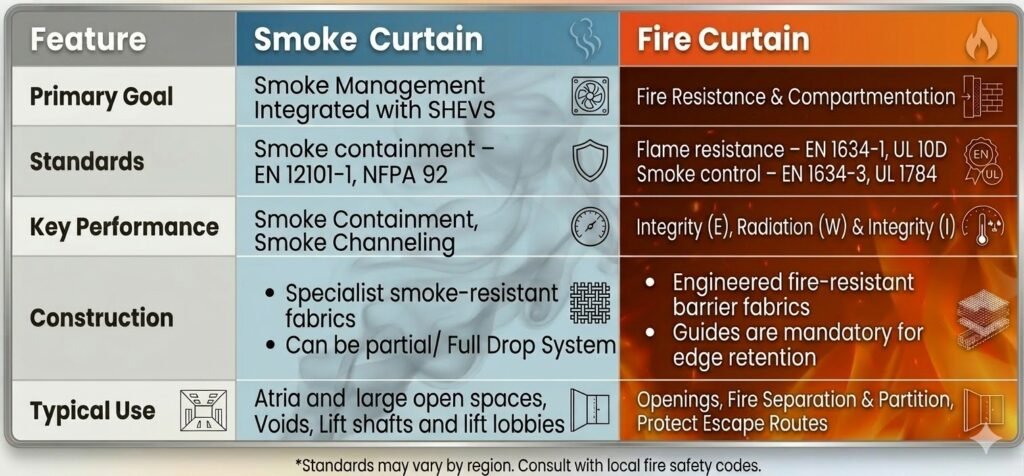
In simple terms, a smoke curtain is mainly for smoke control, while a fire curtain is mainly for fire resistance and separation.
How are their construction details different?
Another practical difference is deployment configuration. Smoke curtains may be designed as either partial-drop or full-drop systems, depending on the smoke-control design and the required smoke reservoir arrangement. Fire curtains, however, are typically full-drop systems because they are intended to close the opening and provide the required fire separation.
Smoke curtains are generally made from specialist smoke-resistant fabrics designed to remain stable and deployed under the temperatures and air movement conditions expected in a smoke control scenario. In many cases, they are comparatively lighter systems because their main role is to contain and direct smoke rather than provide a high level of fire insulation.
Fire curtains are generally manufactured from more heavily engineered fire-resistant barrier fabrics, together with supporting components designed to maintain integrity when exposed to fire. Fire curtains require rigorous edge retention (side guides) to ensure the curtain doesn’t “blow out” under the pressure of a fully developed fire.
Even where the two systems look similar when concealed, the fabric specification, system build-up, edge retention method, and overall assembly details can be significantly different because the intended duty is different.
How are the performance requirements different?
Smoke curtains are assessed based on their ability to act as smoke barriers within a smoke control system. The emphasis is on smoke containment, deployment behaviour, and suitability for use as part of a designed smoke management strategy. In Europe, smoke barriers are commonly associated with EN 12101-1.
Fire curtains are assessed based on fire-resistance performance. The emphasis is on how long the system can maintain its required function when exposed to fire, such as resisting the passage of flames and, where applicable, limiting temperature rise on the non-fire side. In Europe, fire-resisting curtain-type assemblies are commonly referenced against EN 1634-1.
In UL-based and North American project environments, fire-protective curtain assemblies are commonly associated with UL 10D, which covers fire tests of fire-protective curtain assemblies intended to provide supplemental passive fire protection as part of an engineered fire protection system.
Where smoke and draft leakage control is required for opening protectives, the relevant UL reference is commonly UL 1784, which covers air leakage tests of door assemblies and other opening protectives where leakage is intended to be controlled.
This means a smoke curtain should not be assumed to meet the same fire-resistance performance as a fire curtain, and a fire curtain should not automatically be assumed to replace a dedicated smoke control barrier unless that performance has been specifically tested and approved.
Where is each system typically used?
Smoke curtains are commonly used in atriums, shopping centres, airports, escalator voids, and other large open spaces where smoke needs to be channelled or contained as part of a smoke control design.
Fire curtains are commonly used to protect openings, separate spaces, secure void edges, or provide a fire-resisting closure where a fixed wall, shutter, or fire door may not be practical.
Smoke curtains and fire curtains are not the same. They may look similar when installed, but they differ in construction, system design, and performance requirements. The correct choice depends on the building fire strategy, the required tested performance, and the applicable code requirements.

ABIN VARUGHESE
Deputy Manager – Sales & Marketing
Call/ Whatsapp: +971506604689